Author: Brightgate Team

  • Crypto Payment Gateway Solutions: What Businesses Should Evaluate

    Crypto Payment Gateway Solutions: What Businesses Should Evaluate

    Digital commerce continues to evolve as businesses expand into new markets and serve customers across multiple jurisdictions. Alongside traditional payment methods, many organisations are exploring crypto payment gateway capabilities to reduce transaction friction and support international payment acceptance. As customer expectations continue to evolve, businesses are increasingly evaluating crypto payment infrastructure as part of a broader commercial and operational strategy. 

    Rather than viewing cryptocurrency acceptance as a standalone feature, many organisations now assess it as part of a wider payment strategy. The objective is not simply accepting digital assets. It is establishing a payment environment that is consistent with business objectives, customer expectation and long term operational needs. 

    Understanding the Role of a Crypto Payment Gateway

    A crypto payment gateway is a technology layer that enables businesses to accept cryptocurrency payments from customers. Depending on the provider and operating model, it may support payment initiation, transaction confirmation, digital asset conversion, settlement, reporting and integration with existing business systems. 

    Contemporary payment settings tend to entail much more than payment acceptance.  Businesses may evaluate settlement preferences, reporting capabilities, payment conversion options, wallet infrastructure, and operational monitoring requirements before selecting a suitable solution. This is why payment gateway selection has become a strategic business decision. The quality of the infrastructure behind the gateway can influence transaction efficiency, customer experience, and day-to-day operational management.

    Bright Gate Group advises on payment infrastructure requirements and supports the evaluation of suitable independent specialist providers according to business objectives and operational needs. 

    Why Global Businesses Are Exploring Crypto Payments 

    One reason businesses explore cryptocurrency payment solutions is the continued growth of international commerce. Companies operating across multiple jurisdictions often serve customers with different payment preferences. Traditional payment methods remain important, but crypto payment acceptance can provide an additional transaction channel for eligible businesses and customers in supported markets. 

    Digital asset payment environments can support broader payment acceptance strategies while helping businesses assess alternative transaction channels. This may be particularly relevant for international e-commerce businesses, technology companies, digital service providers, financial businesses, and online platforms serving clients across different regions. The objective is not to replace existing payment infrastructure. The goal is to evaluate how additional payment capabilities may fit within the broader business model.

    Security and Operational Reliability Remain Essential

    Security and operational reliability are important considerations when evaluating a crypto payment gateway. Businesses may need to assess transaction security, wallet arrangements, access controls, API security, system availability, operational monitoring, reporting and incident-response procedures before implementation.

    Compliance requirements should also be reviewed according to the business model, transaction flow, customer profile and relevant jurisdictions. Depending on the activities involved, considerations may include KYC and AML controls, sanctions screening, blockchain transaction monitoring, record-keeping and regulatory requirements.

    Bright Gate Group provides strategic advisory and provider-evaluation support. Crypto payment processing, wallet, custody, conversion and settlement services are delivered by the relevant independent providers and remain subject to their compliance procedures, supported jurisdictions, due diligence and approval. 

    Payment Infrastructure Must Fit the Wider Business Environment

    Accepting cryptocurrency payments is not the only aspect of the broader payment environment. The success of a crypto payment gateway can largely be determined by its ability to connect with the overall business operation model. The routing of transactions, settlement, reporting, and operational processes all contribute to the daily payment activity. 

    Most businesses already operate accounting platforms, customer management systems, administrative processes, and financial reporting environments. Payment infrastructure that works alongside these systems can improve visibility across transactions and help create a more streamlined operational structure. As transaction volumes increase, integration between payment activity and wider business operations often becomes increasingly important.

    Businesses evaluating crypto payment solutions frequently assess how customer transactions will be recorded, how settlement information will be managed, and how payment data will support reporting and operational oversight. A well-planned infrastructure framework can help ensure that payment processing supports wider commercial objectives rather than operating as a disconnected function within the organisation.

    Settlement and Conversion Considerations

    Businesses evaluating crypto payment gateways often assess how digital asset transactions will be settled after payment acceptance. Depending on operational requirements, organisations may review settlement preferences, conversion mechanisms, reporting visibility, and treasury-management considerations. 

    These factors can influence cash-flow planning and wider financial operations. Evaluating settlement requirements early can help create stronger alignment between payment activity and broader business objectives.

    Planning Beyond Today’s Transaction Volumes 

    Many businesses begin with relatively straightforward payment requirements. Over time, those requirements can change significantly. New markets may be entered. Transaction volumes may increase. Customer demographics may evolve. Additional products and services may be introduced.

    Payment infrastructure should be capable of supporting these changes without requiring constant restructuring. Scalability is thus a significant factor when evaluating. The advantage of choosing solutions that can be modified as operational needs get more complex is often beneficial to businesses. Early planning for future growth can assist in establishing a more solid base for future development. 

    Evaluating the Right Solution for Your Business Model

    Not every payment gateway is designed for the same type of business. A technology company serving international clients may have different requirements from an e-commerce platform, financial services business, digital marketplace, or software provider. The most effective solution is usually the one aligned with the operational profile of the business rather than the one offering the largest feature list.

    This is where structured evaluation becomes valuable. Understanding transaction patterns, customer locations, settlement preferences, operational requirements, and growth objectives helps businesses identify solutions that support their commercial goals. Bright Gate Group follows an advisory-led approach that focuses on evaluating business requirements before introducing potential infrastructure options.

    How Bright Gate Group Approaches Payment Infrastructure Projects

    Every business has different objectives. Some organisations prioritise international payment acceptance. Others focus on operational efficiency, scalability, settlement flexibility, or infrastructure coordination. 

    Rather than positioning a single solution as suitable for every organisation, Bright Gate Group supports the evaluation of independent specialist providers according to specific business needs. This will assist in establishing a stronger connection between payment infrastructure and long-term business strategy and minimise the risk of choosing solutions that might not meet future needs. 

    Building a Payment Strategy That Supports Growth

    Technology in itself seldom brings about sustained success. Sustainable growth is usually achieved through the choice of infrastructure that can sustain operational goals and at the same time be flexible as business needs change.

    Payment environments are not an exception. Solutions that are more consistent with the business structure and long-term goals are often beneficial to businesses. Companies that strategically consider payment infrastructure tend to be in a better position to meet customer expectations, enhance operational efficiency, and consider future opportunities as digital commerce keeps changing. 

    Beyond Transactions, Building a Smarter Payment Framework

    Electronic payments are turning out to be a significant component of contemporary business processes. The appropriate infrastructure can enable efficiency, flexibility and future expansion and assist businesses in assessing how new payment technologies can be integrated into their broader business strategy. Crypto Payment Gateway Solutions should be assessed as part of a broader operational framework rather than simply a transaction tool.

    Bright Gate Group advises on crypto payment infrastructure and supports the evaluation and coordination of suitable independent specialist providers according to each client’s business objectives, operational requirements and long-term plans. Bright Gate Group does not hold or process customer funds, and all payment, wallet, conversion, custody and settlement services are provided by the relevant independent providers subject to their terms, KYC and compliance requirements. 

  • How Bright Gate Group Supports End-to-End Crypto Exchange Setup 

    How Bright Gate Group Supports End-to-End Crypto Exchange Setup 

    The digital asset industry has grown to a mature stage in the past ten years. What was previously considered a niche market within the financial sector has now developed into a worldwide ecosystem that is appealing to entrepreneurs, technology companies, investment groups and institutional players. With the growing competition, starting an exchange goes far beyond the implementation of software and the listing of digital assets.

    An effective crypto exchange setup depends on how technology, licensing, compliance, liquidity, custody, payment infrastructure and daily operations work together. Each element can influence how the platform is structured and prepared for launch. Bright Gate Group advises businesses on these requirements and coordinates relevant independent specialist input through an advisory-led approach. 

     What a Modern Crypto Exchange Setup Requires 

    Many founders initially focus on platform technology because it is the most visible part of an exchange. However, technology represents only one element within a much larger operational structure. Prior to the commencement of the implementation, businesses are usually required to evaluate ownership structures, jurisdiction issues, compliance, liquidity goals, payment infrastructure, and future operational requirements. Every choice has the potential to affect the overall project success. 

    A structured exchange environment generally combines technology, operational controls, customer onboarding systems, security architecture, liquidity connectivity, and administrative processes. When these components are aligned from the beginning, businesses are often better positioned to scale efficiently as trading activity grows.

    Corporate structuring also forms part of the early planning process. The proposed business model, ownership arrangement and intended activities can influence how the wider exchange project is organised. Company formation and licensing should therefore be considered alongside technology and operational requirements rather than treated as separate decisions. 

    Choosing Technology Around the Trading Model 

    Technology should reflect how the trading business intends to operate rather than being selected as a standalone component. A platform serving retail users may require a different interface and account-management environment from one designed for professional or institutional participants. The same principle applies to asset coverage, execution requirements and the way clients interact with the trading environment.

    Beyond the core trading technology, an exchange also requires an operating environment that supports account administration, reporting, transaction workflows and platform oversight. Administrative controls help define how the platform is managed internally, while reporting systems can provide visibility across user activity and operational processes. 

    Wallet and Custody Planning

    Digital asset exchanges also need a clear approach to wallet and custody infrastructure. Depending on the operating model, businesses may evaluate hot wallets for operational transactions and cold storage for reserve assets. 

    Key-management controls, transaction permissions and wallet monitoring can also form part of the wider architecture. The appropriate structure depends on supported assets, transaction activity, custody arrangements and the requirements of the relevant providers.

    Coordinating Exchange Infrastructure Requirements

    A modern exchange relies on several interconnected technical systems. Infrastructure planning may include the matching engine, order-management system, exchange APIs, market-data feeds, wallet integration, back-office systems, administrative controls and security monitoring. Matching-engine capacity, API response times, order-processing latency, wallet transaction processing and system availability can all affect platform performance as trading activity grows.

    Businesses planning a crypto exchange should therefore assess whether the proposed technology environment can support expected trading volumes, asset coverage, user activity and future expansion.

    Bright Gate Group helps coordinate these evaluations while considering scalability, operational efficiency, and implementation requirements. The objective is not simply to deploy technology but to support the creation of an environment that can evolve alongside the business. 

    Security and Compliance Should Shape the Architecture

    Security should be considered from the start of a crypto exchange setup. The architecture must be able to provide secure user authentication, data protection, wallet security, access controls, and continuous monitoring. Such measures are aimed at minimizing operational risks, securing user accounts, and protecting confidential data. 

    KYC and AML processes should also be built into the exchange workflow rather than added later. Customer verification, transaction monitoring, risk screening, record-keeping and suspicious activity review can help create a structured compliance framework. The exact requirements depend on the exchange model, target markets, and applicable legal framework.

    Crypto exchange licensing, registration and compliance requirements vary according to the jurisdiction, activities, target markets and customer profile. Bright Gate Group provides strategic advisory and project coordination, while jurisdiction-specific legal advice, regulatory applications and regulated compliance services remain with appropriately qualified independent specialists. Any licence or regulatory approval remains subject to the decision of the relevant authority. 

    Liquidity Access Plays an Important Role in Exchange Performance

    Even an advanced trading platform may struggle to attract and retain active market participants without suitable liquidity. Crypto exchange liquidity can affect order-book depth, spreads, slippage, price continuity and execution quality. Exchange operators should therefore assess liquidity providers, market-making arrangements and multi-venue connectivity before launch. 

    Different projects may have different requirements depending on target markets, asset coverage, expected trading activity, and long-term objectives. Some businesses evaluate institutional relationships while others explore broader connectivity options that support market participation. Bright Gate Group advises on liquidity requirements and coordinates relevant specialist input where appropriate. 

    Banking and Payment Infrastructure Supports Operational Continuity

    Exchange infrastructure does not operate in isolation from the wider financial environment. Businesses also need to consider how customers will fund accounts, how withdrawals will be handled, and how settlement processes fit into daily operations.  These considerations often include payment workflows, operational processes, banking objectives, transaction management procedures, and long-term infrastructure planning.

    By evaluating these requirements alongside exchange development, businesses can create a more connected operating framework that supports future scalability and day-to-day functionality.

    Bringing Exchange Components Together Before Launch 

    One of the most common challenges within exchange development is fragmentation. Technology providers may focus on software deployment. Liquidity providers may focus on market connectivity. Experts in banking can specialize in payment infrastructure. Although each of these components is significant, when these areas grow separately, the projects become inefficient. 

    Bright Gate Group supports a more coordinated process by helping businesses evaluate how operational requirements, infrastructure planning, compliance considerations, and commercial objectives interact within a single framework. It can be beneficial to coordinate such dependencies prior to implementation to clarify provider responsibilities and identify technical or operational gaps before they impact launch preparation. 

    Why Long-Term Planning Matters More Than Launch Day

    Launching an exchange is an important milestone, but it represents only the beginning of the journey. Infrastructure requirements tend to change with the increase in user activity. New markets can pose new operational requirements. There might be a need to expand technology environments. The expectations of the customers can keep increasing.

    Companies that strategize such developments early on tend to be more adaptable without significant structural adjustments. That is why most successful exchange projects are not only about launch readiness but also about the creation of an environment that can help to meet the opportunities of the future. 

    Reviewing the Exchange Before Implementation 

    Before implementation begins, businesses can assess the proposed exchange structure against its intended activities, target users and operational requirements. This review can bring technology, liquidity, financial infrastructure and compliance considerations into the same planning framework. It can also highlight dependencies between different providers and identify areas that require specialist input. 

    Bright Gate Group supports this assessment through an advisory and project-coordination model, helping businesses evaluate the proposed structure and coordinate suitable independent specialists around clearly defined commercial and operational objectives. Technology, custody, liquidity, banking, payment and other regulated services are provided by the relevant independent providers and remain subject to their due diligence, contractual terms and approval processes. 

  • Hedge Funds Liquidity Delivery: Key Factors for Better Trade Execution

    Hedge Funds Liquidity Delivery: Key Factors for Better Trade Execution

    Hedge funds are in markets where pricing and execution can have a direct impact on performance. A strong investment strategy needs equally reliable infrastructure behind it. This is where hedge funds liquidity becomes an important part of the trading environment. 

    Liquidity defines the efficiency of a fund to get in and out of positions without unnecessarily impacting the market. It may also affect the spreads, speed of execution, instruments available and the general trading experience. In the case of modern funds, the liquidity of hedge funds is no longer just a matter of locating a source of prices. It entails the creation of an environment in which institutional pricing, market depth, technology and execution workflows interact.

    Why Institutional Liquidity Matters to Hedge Funds

    Institutional trading may have bigger orders and more complex execution needs than regular retail trading. A fund might thus require entry to deeper markets and stronger infrastructure. Institutional liquidity can give hedge funds access to deeper pricing while supporting larger and more complex order flows. 

    For example; a strategy that trades EUR/USD might require different liquidity characteristics than a fund that trades commodities or digital assets. Equally, high-frequency strategies may emphasize latency and connectivity more than longer-term strategies.

    Institutional forex liquidity is particularly relevant for funds with significant foreign exchange exposure. Liquid forex trading may offer access to more competitive institutional spreads and deeper pricing but execution depends on the provider and market. 

    Liquidity Is More Than a Tight Spread

    A narrow spread can look attractive on paper. It does not necessarily convey the full story. A fund should also investigate how it would react to an increase in the order size or volatile markets. Liquidity depth and pricing depth come into play. A richer liquidity environment has the potential to offer more price levels throughout the order book. It can also assist an execution desk to determine how bigger orders might interplay with available liquidity. 

    Other factors include:

    • Market depth: How much tradable volume is available around the current price.
    • Real-time pricing: How quickly prices update as market conditions change.
    • Execution quality: Whether orders are filled consistently according to the intended execution model.
    • Order execution: The actual process through which trading instructions reach the market.
    • Execution routing: How orders are directed toward available liquidity sources.

    These factors collectively shape hedge fund trading liquidity.

    Role of Prime Brokers and Institutional Counterparties

    A prime broker or other institutional counterparty may provide access to markets and other infrastructure to a hedge fund. Prime brokerage relationships may be especially significant to funds which need institutional trading access in multiple venues or asset classes. Prime broker liquidity can co-exist with other liquidity relationships depending on the structure to form a more comprehensive market-access framework.

    An appropriate institutional liquidity provider can provide access to certain instruments, streams of pricing or execution facilities. Prime of prime liquidity may apply when a fund needs an institutional-style market access via an intermediary structure.

    The appropriate structure is based on eligibility, capital, strategy, anticipated volumes and counterparty requirements. Brightgate Group’s Access to Prime Liquidity service explains this assessment-led approach, including evaluation of jurisdiction, execution model, asset classes, projected volume and technology requirements.

    Designing the Hedge Funds Liquidity Infrastructure

    The liquidity of the present day is becoming more technology-oriented. The relationship between a fund and its sources of liquidity may entail a number of technical aspects. An average hedge funds liquidity infrastructure can consist of: 

    • Liquidity feeds
    • Pricing engines
    • Order management systems
    • Execution gateways
    • Bridge connectivity
    • FIX API connectivity
    • Liquidity aggregation technology
    • Risk controls
    • Monitoring and reporting tools

    Liquidity aggregation is especially helpful when a fund requires the assessment of pricing by various sources. The structure of a multi-liquidity source can potentially enhance the comparison of the prices and decrease the reliance on a single counterparty. Using aggregated liquidity, various streams of liquidity can be pooled together using suitable technology. The resulting framework can facilitate more flexible execution routing and wider market access.

    Multi-Asset Liquidity for Modern Strategies

    Numerous hedge funds are no longer targeting a single market. Their plans may cut across multiple asset classes, generating the need for multi-asset liquidity. A multi-asset liquidity provider can serve multiple markets with a connected infrastructure depending on the instruments available and the capabilities of the provider. Possible requirements may be: 

    • Forex liquidity
    • CFD liquidity
    • Commodities liquidity
    • Metals liquidity
    • Index liquidity
    • Equity liquidity
    • Digital asset liquidity

    This generates the necessity of cross-asset liquidity as opposed to single-price relationships. In the case of a fund that trades gold, key currency pairs and equity indices, a coordinated execution environment can streamline the monitoring and operational processes. Various markets continue to possess distinct liquidity attributes and volatility structures. 

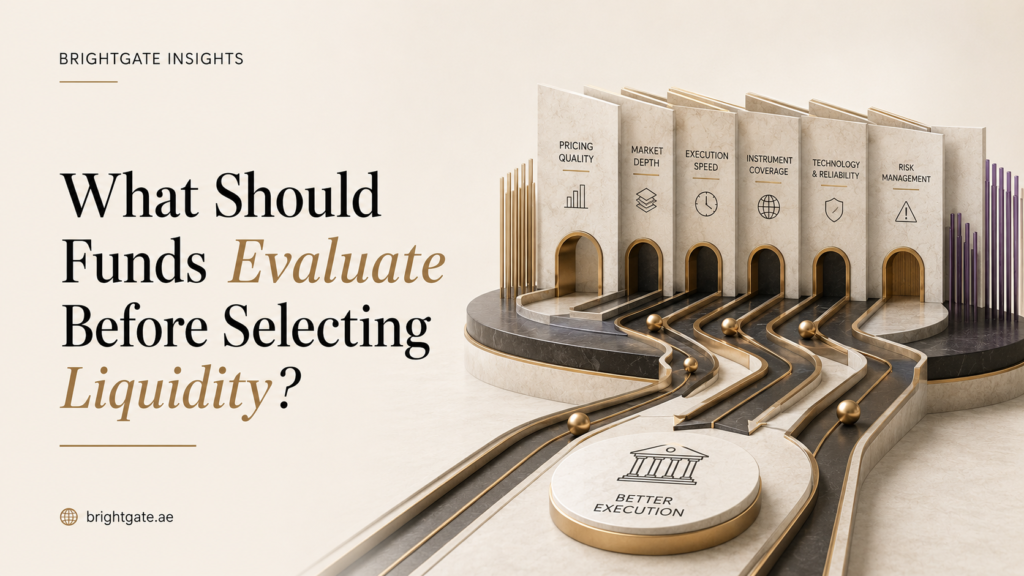
    What Should Funds Evaluate Before Selecting Liquidity?

    Choosing a hedge fund liquidity provider should begin with the fund’s actual requirements. A practical assessment can consider:

    1. Trading strategy: Understand expected instruments, holding periods and order behaviour.
    2. Volume profile: Review average trade size, daily turnover and peak activity.
    3. Asset coverage: Confirm whether required markets and instruments are supported.
    4. Pricing: Compare spreads, depth and overall execution conditions.
    5. Technology: Assess FIX API, bridge connectivity and other technical requirements.
    6. Counterparty structure: Review available institutional counterparties and their eligibility criteria.
    7. Execution model: Understand how orders are routed and handled.
    8. Operational controls: Examine reporting, monitoring and risk-management requirements.

    This process forms the foundation of a practical liquidity sourcing strategy.

    Why Liquidity Diversification Deserves Attention

    Relying on a single liquidity source can create unnecessary counterparty and operational concentration. A diversified structure may make an institution more flexible in response to changing market conditions or a less appropriate source.

    Nevertheless, the increase in the number of providers is not necessarily a good idea. Each new connection may bring technical and operational complexity. Prices of feeds should be checked. Routing logic should be tested. The relationships with counterparties should be maintained. Quality of liquidity access should thus be the goal, not merely increasing the number of connections. 

    Building a Scalable Institutional Trading Environment

    Strong liquidity infrastructure is most effective when it connects with the fund’s wider operational structure. The banking structures, operations and risk structures of the fund must all be in line with the trading model. 

    Brightgate Group’s Financial Business Setup framework highlights liquidity infrastructure alongside technology, banking, risk management and operational requirements. Its current approach focuses on coordinating suitable specialist providers around the specific business structure rather than treating infrastructure as a standalone component.

    The wider perspective is significant since trading infrastructure must be realistic as the trading activity evolves. A design that is suitable when a fund is launched might not suit when volumes are high. The sourcing liquidity strategy must thus be able to accommodate more instruments, counterparties, connectivity and execution needs. 

    When Liquidity Becomes a Trading Advantage 

    The true worth of liquidity is seen when markets are fast and execution is paramount. An intelligent design can provide a hedge fund with a better path into institutional markets and help it in its technology and operational needs. Hedge funds liquidity is thus more of an infrastructure choice rather than a quest to find narrower spreads. Having the right combination of counterparties, market depth and execution technology can make institutional trading more resilient. 

    Ready to structure the right liquidity environment? Brightgate Group advises on institutional liquidity requirements and coordinates suitable independent providers, technology partners and connectivity options around the fund’s specific trading model.

  • How to Select a Forex Liquidity Provider for Your Brokerage

    How to Select a Forex Liquidity Provider for Your Brokerage

    Choosing a Forex Liquidity Provider is one of the most important decisions a brokerage will make. Liquidity influences execution quality, pricing stability, market depth, client experience, and operational performance. A brokerage can invest heavily in trading platforms, marketing, and customer acquisition, but without the right liquidity structure, growth can become difficult.

    The modern brokerage environment is far more complex than it was a decade ago. Brokers now evaluate institutional pricing, technology compatibility, execution models, connectivity requirements, and multiple liquidity relationships before selecting a provider. Selecting the right liquidity arrangement is about more than accessing pricing. The structure should support the brokerage’s execution model, technology environment and long-term growth plans. 

    The Impact of Liquidity on Brokerage Performance 

    Liquidity relationships influence nearly all the activities of brokers. The quality of a foreign exchange liquidity provider may impact spreads, order execution, slippage, market depth, and client retention. When liquidity is structured correctly, brokers may benefit from:

    • Competitive forex spreads
    • Improved execution of forex orders
    • Improved market depth
    • Real-time pricing
    • Greater execution quality
    • Access to institutional liquidity

    When liquidity arrangements are not aligned with operational requirements, brokers may experience wider spreads, inconsistent pricing and execution challenges during active market conditions. 

    Define Your Brokerage’s Liquidity Requirements First 

    It is necessary to know what you need before comparing the providers. Various brokerages require varied kinds of liquidity. Questions to be considered are:

    • Does the brokerage have an A-Book, B-Book or Hybrid model?
    • What trading platforms are in use?
    • What are the asset classes to be provided?
    • What are the expected trading volumes?
    • Which jurisdictions will be served?

    Brightgate Group advises that liquidity arrangements should be assessed according to execution requirements, trading volume, client activity, technology infrastructure and business objectives. 

    Assess Market Depth and Available Liquidity Sources 

    The availability of deep liquidity pools is one of the initial factors to consider. A good forex liquidity provider must provide adequate market depth in key and applicable trading instruments. The depth is especially significant in times of high volatility when the order flow is high. Liquidity depth affects:

    • Large order execution
    • Price stability
    • Slippage control
    • Market access
    • Execution consistency

    Most institutional trading settings are based on aggregated liquidity provided by a group of counterparties as opposed to a single source of liquidity. 

    Review Execution Quality Beyond Spreads 

    There are numerous new brokers who consider spreads as the only important factor in assessing a liquidity provider forex relationship. While spreads are important, they tell only part of the story. A broker with very narrow spreads does not necessarily provide better execution. Other factors include:

    • Execution speed
    • Rejection rates
    • Fill quality
    • Market depth
    • Order routing efficiency
    • Sustainability in fluctuating markets.

    An assessment should be done on the overall performance of execution and not just headline pricing. 

    Evaluate Aggregation and Connectivity Technology 

    Liquidity aggregation is becoming more and more popular in modern brokerages to enhance the execution results. Liquidity aggregation combines pricing and executable liquidity from multiple sources within a single trading environment. The result can be improved market depth, broader liquidity access and more competitive pricing. The advantages of liquidity aggregation technology are:

    • Aggregated liquidity
    • Price aggregation
    • Multi-liquidity source access
    • Improved execution routing
    • Better market coverage

    Aggregation has become a fundamental part of the broker liquidity infrastructure of many brokerages. 

    Evaluate Technology Infrastructure and Connectivity Requirements 

    The compatibility of technology is equally important as liquidity itself. A brokerage may have access to competitive pricing, but operational challenges can arise if connectivity and infrastructure requirements are not properly aligned. The important technology considerations are:

    • FIX API liquidity
    • Bridge connectivity
    • Forex bridge solutions
    • Liquidity management systems
    • Forex connectivity solutions
    • Trading technology infrastructure

    The liquidity space must be compatible with platforms like MetaTrader 5, cTrader, Match-Trader, and other institutional trading systems. Platform compatibility and connectivity requirements should be assessed as part of the overall liquidity evaluation process. 

    Understanding Prime Liquidity and Institutional Market Access 

    Access is explored by many brokerages via a prime liquidity provider or a prime-of-prime liquidity arrangement. Such relationships can give access to:

    • Institutional pricing
    • Institutional counterparties
    • Broader liquidity sourcing
    • Multi-asset liquidity
    • Institutional forex trading environments 

    Nevertheless, institutional liquidity is still available under counterparty due diligence, eligibility and approval procedures. Liquidity relationships organized via Brightgate are still subject to the provisions and approval procedures of independent providers. 

    Review Multi-Asset Expansion Requirements 

    There are numerous contemporary brokers that are no longer concerned with currencies. An appropriate multi-asset liquidity provider can facilitate access to:

    • Forex
    • Metals
    • Commodities
    • Indices
    • CFDs
    • Additional trading instruments

    Multi-asset liquidity gains greater significance as the product range of brokerages grows, which is essential for long-term scalability. 

    Examine Operational Support and Connectivity

    Selecting a liquidity relationship involves more than comparing providers and pricing structures. The implementation process should be considered alongside pricing and liquidity access. A brokerage must consider:

    • Trading infrastructure
    • Connectivity planning
    • Execution workflows
    • Testing procedures
    • Operational readiness
    • Routing structures

    Successful implementation depends on liquidity technology and execution infrastructure operating together within the trading environment. 

    Compare Multiple Providers Before Making a Decision

    One should never choose a forex market liquidity provider on the basis of one offer. Brokerages should compare: 

    • Tier 1 liquidity providers
    • Prime brokers
    • Prime of prime providers
    • ECN environments
    • Market makers
    • Specialized liquidity sources

    The most suitable solution is usually the one that fits best with the operational profile of the brokerage and not necessarily the biggest in the market. 

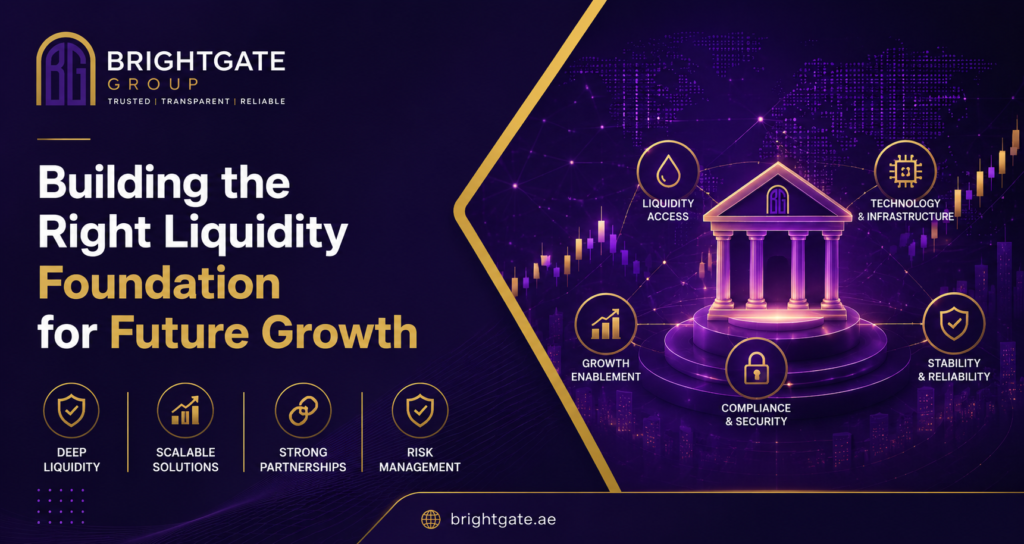
    Building the Right Liquidity Foundation for Future Growth 

    An effective brokerage is founded on more than appealing spreads and trading technology. The appropriate liquidity structure facilitates the quality of execution, stability in operations and long-term growth. Prior to choosing a Forex Liquidity Provider, brokerages must critically evaluate their model of execution, technology needs, asset coverage and business goals. An organized assessment procedure can assist in determining liquidity connections that can sustain existing activities as well as growth in the future. 

    Explore Liquidity Infrastructure Options with Brightgate 

    Selecting a Forex Liquidity Provider involves evaluating execution quality, market access, connectivity requirements and long-term operational objectives. The right liquidity structure can influence execution quality, market access, operational efficiency and future growth. Brightgate Group advises on liquidity infrastructure requirements and supports the evaluation of independent liquidity relationships according to your brokerage’s objectives, technology environment, and execution model. Review available liquidity arrangements and assess which structure best aligns with your brokerage’s objectives and operational requirements.