Category: Insights

  • Crypto Exchange Setup: Key Components Every Business Needs

    Crypto Exchange Setup: Key Components Every Business Needs

    Launching a successful Crypto Exchange involves far more than building a trading interface and listing digital assets. The digital asset industry has become increasingly competitive as institutional participation grows and new trading platforms enter the market. 

    The digital asset industry is constantly changing with institutional investors entering and new markets being created. Companies venturing into this space have to consider several elements prior to entering. An organized trade involves a blend of reliable infrastructure, effective trading systems, planning of regulation, and scalable operating systems. When these factors are put in place at the start, exchanges are in a better position to facilitate growth and adjust to the market dynamics.

    Understanding the Foundation of a Modern Exchange

    Every Crypto Exchange Setup begins with strategic planning. The success of an exchange is often determined long before the first trade takes place. The choice of technology, compliance planning, access to liquidity, banking structure, and operational processes should collaborate as a component of a larger business structure. A contemporary Digital Asset Exchange Arrangement generally entails a number of interdependent elements that facilitate day-to-day activities. These may include:

    • Trading platform infrastructure
    • Exchange backend systems
    • Customer onboarding environments
    • Compliance infrastructure
    • Banking and payment connectivity.
    • Liquidity access frameworks
    • Custody and security settings.

    Companies that treat exchange development as an ecosystem tend to establish more robust bases as compared to those that concentrate on software deployment. 

    Defining the Right Exchange Business Model

    The desired business model should be defined before any Crypto Trading Platform Setup is initiated. Various exchanges cater to various audiences and markets. Others are targeted at retail traders and others at institutional participants or professional trading firms.

    The selected structure determines the operational needs, liquidity requirements and the architecture of technology. A well-defined business model can assist in making future decisions on infrastructure, market access and long-term expansion opportunities. A good crypto exchange business setup must be able to accommodate the needs of the present and provide the flexibility to accommodate future needs as the trading activity and customer demand change. 

    Exchange Technology Drives Performance

    Technology is at the heart of any successful exchange. Infrastructure quality determines the speed of execution, platform stability, security and user experience. A contemporary Crypto Exchange Platform usually depends on a number of essential elements:

    • Matching Engine
    • Crypto Trading Engine
    • Order Matching System
    • Exchange Software
    • Exchange API Integration
    • Market Data Integration
    • Exchange Backend Systems

    The Matching Engine is especially significant as it handles buy and sell orders and ensures market efficiency. With the growth in trading volumes, infrastructure scalability becomes more relevant. White Label Crypto Exchange environments are also assessed in many projects to speed up the deployment schedule without compromising operational flexibility. 

    Security Must Be Built Into the Infrastructure

    Security is also among the most crucial factors in crypto exchange setup. Exchange operators have to secure customer assets, transaction data, and platform integrity. An all-encompassing Exchange Security Infrastructure can comprise:

    • Multi-factor authentication
    • Cold storage environments
    • Custody Solutions
    • Crypto Wallet Integration
    • Multi-Currency Wallet support
    • Penetration testing procedures
    • Network monitoring systems

    Security is not a distinct functionality. It should be incorporated into the whole exchange environment from the initial planning stages. 

    Compliance Has Become a Core Business Requirement

    The regulatory expectations are still evolving in the international digital asset markets. Consequently, compliance planning has emerged as a significant part of any virtual asset exchange setup. A successful exchange compliance framework can be characterized by multiple layers of controls and procedures that are aimed at facilitating operational integrity and regulatory preparedness.

    Some of the areas that are usually reviewed are:

    • KYC Solutions & AML Compliance
    • Customer Verification Systems
    • Transaction Monitoring
    • Anti-Money Laundering Controls
    • Compliance Infrastructure
    • Risk Management Systems

    Most exchange operators also consider more general regulatory strategy requirements that can be relevant to their target markets. Brightgate Group provides strategic, non-legal guidance on compliance planning and coordinates with qualified legal, regulatory and compliance professionals where specialist advice is required.

    Banking and Payment Infrastructure Supports Growth

    An effective payments environment may include payment gateway integration, banking solutions and fiat off-ramp solutions that help connect customers with the exchange environment. These systems support deposits, withdrawals and transaction processing while contributing to a smoother user experience. 

    Banking relationships can be significant in maintaining continuity of operations and accessibility to customers. Payment infrastructure is not to be considered as a separate entity but as an element that should be evaluated in terms of compliance and business requirements. 

    Liquidity Determines Market Quality

    An exchange may be well-equipped with technology, yet the trading may be minimal due to a lack of liquidity. This is the reason why liquidity planning is a very important aspect of exchange infrastructure setup projects. Exchanges in the modern world tend to judge:

    • Crypto Liquidity Solutions
    • Liquidity Providers
    • Institutional Liquidity
    • Deep Liquidity Access
    • Market Making Services
    • Multi-Exchange Liquidity
    • Trading Volume Solutions
    • Market Access Solutions

    Liquidity can influence order-book depth, execution consistency and pricing availability during active market conditions. Exchanges often evaluate how liquidity sources perform under varying trading volumes rather than focusing solely on headline spreads. 

    Execution Performance and Market Operations 

    The performance of platforms and user satisfaction can be directly impacted by the quality of execution. With the growth in trading volumes, exchanges need infrastructure that can support an expanding activity without reducing reliability. Some of the most important elements that are frequently examined are trade execution infrastructure, market data integration and liquidity infrastructure.

    The effectiveness of these systems in interacting with each other is often important in terms of operational efficiency. Infrastructure planning must thus take into account the present needs as well as future scalability. 

    Creating a Scalable Exchange Environment

    One of the most common mistakes in exchange development is focusing only on launch requirements. As trading activity grows, additional demands are placed on infrastructure, compliance processes, payment systems and customer support functions. A scalable exchange environment normally takes into account:

    • Future user growth
    • Additional trading pairs
    • New geographic markets
    • Expanded payment capabilities
    • Enhanced security controls
    • Additional liquidity relationships

    Companies that strategize to grow in the future during the development stage tend to be more flexible to changes as the operations grow. 

    Coordinating the Components of Exchange Development

    Building a digital asset platform involves much more than deploying technology. The ultimate outcome is due to company formation, compliance planning, banking infrastructure, and operational structures.

    This is the reason why a lot of enterprises treat Crypto Brokerage Setup and exchange development as a coordinated initiative and not an isolated technology implementation. The aim is to establish a situation in which every element underpins the overall business model and long-term commercial strategy. 

    Building the Right Foundation Before Growth Begins 

    Bright Gate Group provides strategic advisory and project coordination for crypto exchange setup initiatives. Our role includes assessing technology, compliance, liquidity, banking and operational requirements and coordinating suitable independent providers. All regulated services, licences, banking relationships, custody arrangements, liquidity access and technology solutions remain subject to applicable laws, independent provider agreements, due diligence and third-party approval. 

    Learn more through Brightgate Group and assess which exchange structure best aligns with your long-term business objectives.

  • Hedge Funds Liquidity Delivery: Key Factors for Better Trade Execution

    Hedge Funds Liquidity Delivery: Key Factors for Better Trade Execution

    Hedge funds are in markets where pricing and execution can have a direct impact on performance. A strong investment strategy needs equally reliable infrastructure behind it. This is where hedge funds liquidity becomes an important part of the trading environment. 

    Liquidity defines the efficiency of a fund to get in and out of positions without unnecessarily impacting the market. It may also affect the spreads, speed of execution, instruments available and the general trading experience. In the case of modern funds, the liquidity of hedge funds is no longer just a matter of locating a source of prices. It entails the creation of an environment in which institutional pricing, market depth, technology and execution workflows interact.

    Why Institutional Liquidity Matters to Hedge Funds

    Institutional trading may have bigger orders and more complex execution needs than regular retail trading. A fund might thus require entry to deeper markets and stronger infrastructure. Institutional liquidity can give hedge funds access to deeper pricing while supporting larger and more complex order flows. 

    For example; a strategy that trades EUR/USD might require different liquidity characteristics than a fund that trades commodities or digital assets. Equally, high-frequency strategies may emphasize latency and connectivity more than longer-term strategies.

    Institutional forex liquidity is particularly relevant for funds with significant foreign exchange exposure. Liquid forex trading may offer access to more competitive institutional spreads and deeper pricing but execution depends on the provider and market. 

    Liquidity Is More Than a Tight Spread

    A narrow spread can look attractive on paper. It does not necessarily convey the full story. A fund should also investigate how it would react to an increase in the order size or volatile markets. Liquidity depth and pricing depth come into play. A richer liquidity environment has the potential to offer more price levels throughout the order book. It can also assist an execution desk to determine how bigger orders might interplay with available liquidity. 

    Other factors include:

    • Market depth: How much tradable volume is available around the current price.
    • Real-time pricing: How quickly prices update as market conditions change.
    • Execution quality: Whether orders are filled consistently according to the intended execution model.
    • Order execution: The actual process through which trading instructions reach the market.
    • Execution routing: How orders are directed toward available liquidity sources.

    These factors collectively shape hedge fund trading liquidity.

    Role of Prime Brokers and Institutional Counterparties

    A prime broker or other institutional counterparty may provide access to markets and other infrastructure to a hedge fund. Prime brokerage relationships may be especially significant to funds which need institutional trading access in multiple venues or asset classes. Prime broker liquidity can co-exist with other liquidity relationships depending on the structure to form a more comprehensive market-access framework.

    An appropriate institutional liquidity provider can provide access to certain instruments, streams of pricing or execution facilities. Prime of prime liquidity may apply when a fund needs an institutional-style market access via an intermediary structure.

    The appropriate structure is based on eligibility, capital, strategy, anticipated volumes and counterparty requirements. Brightgate Group’s Access to Prime Liquidity service explains this assessment-led approach, including evaluation of jurisdiction, execution model, asset classes, projected volume and technology requirements.

    Designing the Hedge Funds Liquidity Infrastructure

    The liquidity of the present day is becoming more technology-oriented. The relationship between a fund and its sources of liquidity may entail a number of technical aspects. An average hedge funds liquidity infrastructure can consist of: 

    • Liquidity feeds
    • Pricing engines
    • Order management systems
    • Execution gateways
    • Bridge connectivity
    • FIX API connectivity
    • Liquidity aggregation technology
    • Risk controls
    • Monitoring and reporting tools

    Liquidity aggregation is especially helpful when a fund requires the assessment of pricing by various sources. The structure of a multi-liquidity source can potentially enhance the comparison of the prices and decrease the reliance on a single counterparty. Using aggregated liquidity, various streams of liquidity can be pooled together using suitable technology. The resulting framework can facilitate more flexible execution routing and wider market access.

    Multi-Asset Liquidity for Modern Strategies

    Numerous hedge funds are no longer targeting a single market. Their plans may cut across multiple asset classes, generating the need for multi-asset liquidity. A multi-asset liquidity provider can serve multiple markets with a connected infrastructure depending on the instruments available and the capabilities of the provider. Possible requirements may be: 

    • Forex liquidity
    • CFD liquidity
    • Commodities liquidity
    • Metals liquidity
    • Index liquidity
    • Equity liquidity
    • Digital asset liquidity

    This generates the necessity of cross-asset liquidity as opposed to single-price relationships. In the case of a fund that trades gold, key currency pairs and equity indices, a coordinated execution environment can streamline the monitoring and operational processes. Various markets continue to possess distinct liquidity attributes and volatility structures. 

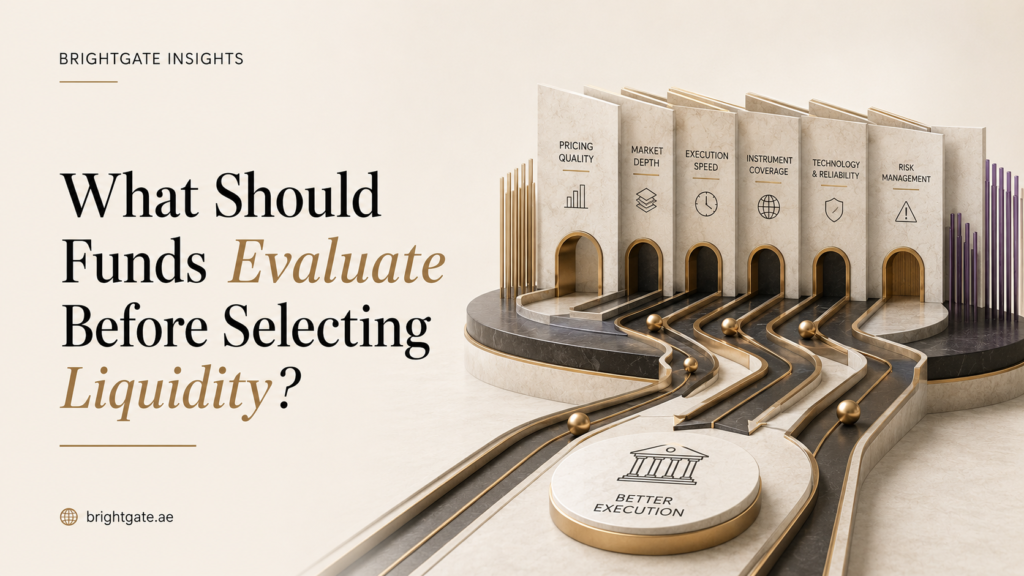
    What Should Funds Evaluate Before Selecting Liquidity?

    Choosing a hedge fund liquidity provider should begin with the fund’s actual requirements. A practical assessment can consider:

    1. Trading strategy: Understand expected instruments, holding periods and order behaviour.
    2. Volume profile: Review average trade size, daily turnover and peak activity.
    3. Asset coverage: Confirm whether required markets and instruments are supported.
    4. Pricing: Compare spreads, depth and overall execution conditions.
    5. Technology: Assess FIX API, bridge connectivity and other technical requirements.
    6. Counterparty structure: Review available institutional counterparties and their eligibility criteria.
    7. Execution model: Understand how orders are routed and handled.
    8. Operational controls: Examine reporting, monitoring and risk-management requirements.

    This process forms the foundation of a practical liquidity sourcing strategy.

    Why Liquidity Diversification Deserves Attention

    Relying on a single liquidity source can create unnecessary counterparty and operational concentration. A diversified structure may make an institution more flexible in response to changing market conditions or a less appropriate source.

    Nevertheless, the increase in the number of providers is not necessarily a good idea. Each new connection may bring technical and operational complexity. Prices of feeds should be checked. Routing logic should be tested. The relationships with counterparties should be maintained. Quality of liquidity access should thus be the goal, not merely increasing the number of connections. 

    Building a Scalable Institutional Trading Environment

    Strong liquidity infrastructure is most effective when it connects with the fund’s wider operational structure. The banking structures, operations and risk structures of the fund must all be in line with the trading model. 

    Brightgate Group’s Financial Business Setup framework highlights liquidity infrastructure alongside technology, banking, risk management and operational requirements. Its current approach focuses on coordinating suitable specialist providers around the specific business structure rather than treating infrastructure as a standalone component.

    The wider perspective is significant since trading infrastructure must be realistic as the trading activity evolves. A design that is suitable when a fund is launched might not suit when volumes are high. The sourcing liquidity strategy must thus be able to accommodate more instruments, counterparties, connectivity and execution needs. 

    When Liquidity Becomes a Trading Advantage 

    The true worth of liquidity is seen when markets are fast and execution is paramount. An intelligent design can provide a hedge fund with a better path into institutional markets and help it in its technology and operational needs. Hedge funds liquidity is thus more of an infrastructure choice rather than a quest to find narrower spreads. Having the right combination of counterparties, market depth and execution technology can make institutional trading more resilient. 

    Ready to structure the right liquidity environment? Brightgate Group advises on institutional liquidity requirements and coordinates suitable independent providers, technology partners and connectivity options around the fund’s specific trading model.

  • Why the Right Company Formation Matters for Forex and CFD Brokers

    Why the Right Company Formation Matters for Forex and CFD Brokers

    Many brokerage founders focus on trading platforms and client acquisition. While these areas are important to the success of a brokerage often begins much earlier. The company structure selected at the start can influence future banking opportunities, licensing pathways and expansion plans.

    Company formation is not simply an administrative step for Forex and CFD Brokers. It is one of the most important strategic decisions made during the development process. The chosen structure can affect how the business operates and how easily it adapts to future requirements.

    Company Formation Provides the Foundation for Brokerage Planning 

    There are several elements to a brokerage and all the factors mentioned below are usually determined by the legal framework that is implemented initially.

    The chosen structure and jurisdiction can be relevant factors when evaluating future banking requirements. Formation decisions may affect future flexibility and the effectiveness with which various components of the business collaborate. The formation of companies is considered by many established players in the industry as the basis on which the whole ecosystem of brokerage is built. 

    Jurisdiction Selection Influences Future Opportunities

    Jurisdiction selection is one of the initial considerations when forming a company. Various jurisdictions have varying commercial environments and operational structures. The jurisdiction can affect:

    • Banking access
    • Corporate requirements
    • Operational obligations
    • Market accessibility
    • Business costs
    • Expansion opportunities

    What is a structure that fits one business model may not fit another. This is the reason why the choice of jurisdiction must be in line with long-term goals as opposed to short-term convenience. We recommend an assessment of company formation based on target markets, licensing strategy, banking requirements and future growth plans. 

    Banking Relationships Often Begin with Structure

    Banking is also among the most significant operational needs of brokerage businesses. Banks tend to scrutinize the business structure and jurisdiction before considering a company.

    • An effective formation strategy can be used to establish more alignment between the company’s goals and future banking needs.
    • Early consideration of banking requirements can help businesses prepare a more coherent structure for future banking discussions. This is among the reasons why structure and banking are often considered jointly in the planning phase. 

    Licensing Pathways Should Be Considered Early

    One of the most misunderstood ones is that the registration of a company automatically establishes the right to conduct a brokerage. Formation and licensing of companies are two different issues. The chosen structure may affect the further licensing directions and planning of operations. Businesses considering regulated activities can benefit from assessing relevant licensing requirements alongside company formation planning. 

    Brightgate Group emphasises that registration of a company does not necessarily permit regulated brokerage operations and that decisions on formation must be taken into account with the prospective licensing needs.  

    Ownership Structure Supports Long-Term Stability

    The formation of a company is also a chance to create a definite ownership structure. Founders often concentrate on the launch activities and do not pay attention to the impact that ownership structures can have on decision-making in the future. Planning early will assist in developing a framework that will facilitate business development in the long run. It is not just about launching effectively. The aim is to develop a framework that will be appropriate as the brokerage changes. 

    Technology Planning Benefits from Early Structural Decisions

    Technology requirements should also be considered during the planning stage so the corporate structure can accommodate the brokerage’s intended operating model. 

    • The choice of technology is usually given a lot of focus when launching a brokerage. Nevertheless, planning of technology is more efficient when it is backed by a framework that is geared towards future operational needs.
    • A coordinated strategy assists businesses in assessing infrastructure requirements in the framework of their overall business strategy and not as independent technology initiatives. 

    Operational Efficiency Starts Before Launch

    Most of the operational problems can be traced to the decisions made during the planning process. Companies that strategically plan their business formation usually find it easier to align various functions of business operations as they expand. The areas that could be considered for early planning include: 

    • Client onboarding
    • Payment workflows
    • Reporting processes
    • Internal administration
    • Technology integration
    • Business scalability

    A suitable corporate framework can help businesses plan operational requirements more coherently as they develop. 

    Growth Requires More Than Registration

    Company registration is just a part of a much bigger development process. The ability of the business structure to facilitate future goals is usually a determinant of sustainable growth. The significance of the initial formation decision can be even more evident as the brokerages enter new markets, add new services, or improve their functioning capacity. Companies that strategize early on to meet future needs tend to be in a better position to respond to opportunities as they arise. 

    Company Formation and Infrastructure Work Together

    An effective brokerage is seldom based on one element. The broader business framework consists of company formation, banking relationships, technology infrastructure, payment systems, CRM environments, and operational planning.

    Brightgate Group advises that brokerage development is a process that involves the coordination of interrelated elements as opposed to considering each requirement separately. This broader approach can provide a more structured basis for future business planning. 

    The Structure You Choose Today Shapes Tomorrow’s Brokerage

    Numerous brokerage projects are concerned with what is required to start. The most successful businesses tend to concentrate on what is likely to be required to expand. Registration is not the sole issue with the formation of companies. It is concerned with the development of a framework that facilitates future banking relationships, operational effectiveness, technology planning, and business growth. A well-thought-out base can be used to minimize the challenges that may arise in the future and to establish more flexibility as the business grows. 

    Explore Company Formation Options with Brightgate Group

    Brightgate Group advises on company formation projects for Forex and CFD brokers and supports the evaluation of jurisdiction options, business structures, banking considerations, and operational requirements. Learn more through the Company Formation Services page and assess which structure best aligns with your long-term business objectives.

  • How the Right Forex Liquidity Provider Can Support Brokerage Growth

    How the Right Forex Liquidity Provider Can Support Brokerage Growth

    The liquidity infrastructure is a core component of a contemporary Forex brokerage that affects the pricing, execution, and operational capacity. A Forex Liquidity Provider links brokers and liquidity providers and tradable prices in currency pairs and other instruments. The selection of a provider is not simply a matter of comparing spreads with the constantly changing market conditions and trading technology in 2026. 

    The appropriate liquidity structure must also be aligned with the trading model, anticipated volumes, the variety of instruments, and the technical structure of the brokerage. The liquidity framework can be impacted by factors like market depth and risk management which can affect the performance of the liquidity framework in practice. This is why liquidity planning must be taken into account in the context of the broader needs of the brokerage’s work.

    What Is a Forex Liquidity Provider and How Does It Work?

    A liquidity provider is a financial institution or market participant that supplies tradable prices and liquidity to a brokerage. These prices can support the brokerage’s execution framework across currency pairs and other available instruments. 

    How Liquidity Reaches the Brokerage

    The process generally involves several connected parties:

    • Direct liquidity providers: Supply prices and liquidity directly to the brokerage. 
    • Prime brokers: Facilitate access to institutional liquidity networks, subject to their own eligibility and commercial requirements. 
    • Prime-of-Prime providers: Connect brokers with institutional liquidity sources where direct prime-broker relationships may not be available. 
    • Liquidity aggregators: Combine pricing from multiple sources through a common liquidity connection. 

    These relationships form part of the broader pricing and execution infrastructure. Trading platforms and connected technology then facilitate the flow of orders between the brokerage and its clients. 

    Why Liquidity Quality Matters to a Brokerage

    Liquidity quality is an important factor in how orders are priced and executed. Adequate liquidity may support greater market depth and more stable pricing throughout the trading conditions. 

    Key Factors to Consider

    • Market depth: Greater available volume can help accommodate larger orders with less price impact. 
    • Bid-ask spreads: Competitive spreads may help to minimize trading costs.
    • Order execution: Available liquidity can influence how efficiently orders are filled at quoted prices. 
    • Slippage: Limited available liquidity can increase the difference between the expected and executed price. 
    • Fill rates: Available liquidity can influence the likelihood and completeness of order fills. 

    A small quoted spread in itself does not provide superior execution. Spreads may increase in volatile or low-volume times and liquidity may fluctuate rapidly. 

    How the Right Provider Can Influence Trade Execution

    The quality of execution is determined by the speed and regularity with which orders are transferred to the available liquidity through the brokerage. 

    • Speed of execution: Delays may have an impact on the ultimate price obtained.
    • Order routing: Routing arrangements can determine how orders reach available liquidity sources. 
    • Fill rates: Consistent fills can indicate that sufficient liquidity is available for the relevant order flow. 
    • Requotes: Repeat requotes can have an impact on order processing.
    • Partial fills: Larger orders can be filled in multiple fills when there is limited depth.
    • Slippage: Between the time of order submission and execution, there may be positive or negative price movement.

    The execution of the trade should be evaluated under normal, volatile, and low-volume market conditions. 

    Spreads, Pricing and the Real Cost of Execution

    Quoted forex spreads indicate the difference between the ask and bid prices but do not reflect the entire cost of a trade. A pricing structure may include raw spreads or other execution-related costs. Slippage may also result in execution costs especially in cases where market prices are volatile. Pricing must be evaluated in conjunction with the actual performance quality. 

    A tighter spread might not result in lower total costs when orders experience frequent slippage or poor fills. The pricing should be re-examined under both normal and volatile market conditions because spreads, liquidity available, and cost of execution may vary greatly when the trading activity or market volatility is high. 

    Single-Provider vs Multi-Provider Liquidity Models

    A brokerage may deal with a single Forex Liquidity Provider or have access to multiple liquidity providers based on its trading model and infrastructure. A single provider system can make integration and day-to-day management easier. A multi-provider model may offer access to a wider range of pricing, liquidity, redundancy, and instrument variety, such as multi-asset liquidity in Forex and CFDs. 

    Comparing the Two Approaches

    • Single provider: Simpler connectivity and fewer operational dependencies.
    • Multiple providers: More pricing sources and greater flexibility.
    • Aggregation: Combines quotes from different sources through a common infrastructure.
    • Complexity: Multiple connections require stronger monitoring, reconciliation, routing, and technical support.

    Common Mistakes When Selecting Liquidity

    Selecting liquidity based only on advertised pricing can create gaps between expected and actual operating requirements. 

    • Advertised spreads do not show the full execution experience. Brokers should also consider fills, slippage, requotes, and execution consistency. Brokers can also choose liquidity without verifying instrument coverage and reconciliation requirements. 
    • Another common mistake is assuming that the same liquidity model will suit every brokerage. Liquidity requirements may vary depending on the trading volumes and client activity. A systematic evaluation assists in determining the gaps before integration and enhances operational planning. 

    How Liquidity Requirements Change as a Brokerage Grows

    The liquidity requirements tend to vary with the development of trading and infrastructure. Future scalability of the brokerage should be taken into account in early planning and not just the current volumes. 

    Different Stages – Different Requirements

    • Early-stage brokerage: Basic connectivity and manageable initial trading volumes are frequently the primary focus.
    • Growing Brokerage: Larger volumes of orders can demand enhanced connectivity and market depth.
    • Established brokerage: Multi-asset trading, multiple liquidity sources, more advanced execution infrastructure, and stronger redundancy requirements may become relevant. 

    A configuration that is effective at the start can become limiting as the order flow grows. Early reviews of the expected trading volumes and technology requirements can assist in minimizing the need to make significant changes to infrastructure in the future. Liquidity planning should therefore consider expected trading activity and technology requirements rather than focusing only on launch-stage needs. 

    Liquidity Strategy Considerations for Forex Brokerages 

    Liquidity selection is an infrastructure and operational decision. The appropriate arrangement depends on factors such as trading volumes, business model, instrument coverage, technical requirements, and future operational needs. An effective liquidity structure may enable the brokerage to be flexible as the trading activity evolves not necessarily based on a single factor. 

    Brightgate Group advises on liquidity strategy and coordinates relevant solutions based on the brokerage’s operational requirements and growth plans.

  • Forex and CFD Brokerage Formation Solutions for International Markets

    Forex and CFD Brokerage Formation Solutions for International Markets

    Establishing a Forex and CFD Brokerage for international markets requires more than selecting a trading platform and launching a website. Modern brokerage businesses operate within a highly competitive environment where technology, operational planning, market access, and business structure all play an important role in long-term success.

    As international financial markets continue to expand, many entrepreneurs, financial groups, and investment firms are exploring opportunities within the brokerage sector. While the opportunity can be significant, the development process often involves multiple stages that must work together effectively from the beginning. A structured approach helps create a stronger foundation while supporting future growth objectives across different regions and client segments.

    Understanding the Modern Brokerage Environment

    The brokerage sector has been changing significantly in the past ten years. The expectations of clients are growing and the level of technology is getting higher. Companies venturing into the industry need to think through the operating model that will enable it to grow over time instead of concentrating on the launch operations.

    The key to a successful forex and CFD brokerage is often a well-defined business strategy that helps to match the operational needs with the commercial goals. The choices made at the initial planning phases often affect scalability and future expansion opportunities. This is the reason why most companies start by assessing their market goals prior to undertaking infrastructure choices. 

    Selecting the Appropriate Business Model

    All CFD brokers have a different manner of operation according to the market and their commercial interests. There are those businesses that target retail players and those that target professional and institutional market segments.

    The model selected affects the technology needs, operations, client onboarding processes, and general business planning. Having a clear picture of the targeted market will assist businesses in developing a framework that will facilitate the short-term needs as well as the long-term developmental prospects. The best structures are the ones that are planned with long-term goals in mind as opposed to short-term launch plans. 

    Planning International Market Entry

    An effective forex broker arrangement starts with proper planning. The international markets have various commercial environments and operational needs that ought to be evaluated before the commencement of the implementation.

    Market-entry planning can entail the examination of corporate structure alternatives and client acquisition plans. Every decision is part of the general business structure. When these factors are evaluated in combination, the businesses are usually in a better position to proceed with more clarity and confidence. 

    Building an Effective Operational Framework

    The quality of an operational structure often determines the strength of a CFD broker set-up. The processes that seem to be easy at the initial launch phase may prove to be more crucial as the trading volume and number of clients increase.

    Operational planning is normally concerned with the establishment of a condition where various business functions can collaborate effectively. Onboarding of clients, internal reporting, processing of payments and administration of business all lead to overall effectiveness of the organisation. Companies that take time in operational planning tend to have an easier time controlling future expansion as well as being consistent in various sections of the company. 

    Technology Remains Central to Brokerage Development

    One of the most significant aspects of any online trading brokerage is technology. The contemporary market players demand stable systems and effective account-management features.

    The technology infrastructure can consist of trading systems, client management systems, reporting systems, hosting systems and connectivity infrastructure. It is not merely about installing software. The decisions made on technology must be in line with the efficiency of operations and must provide a structure that can be adapted to meet future business needs. Technology planning is one of the major aspects of long-term development of brokerage as the expectations of clients keep changing. 

    Creating a Strong Client Experience

    Every forex trading broker operates within an environment where client experience can influence long-term business performance. Market participants increasingly expect smooth onboarding processes, reliable trading environments, and efficient operational support.

    Businesses that focus on creating a structured client journey often benefit from stronger client engagement and improved operational consistency. A well-organised framework can also support future growth by reducing inefficiencies and creating a more scalable operating environment. Client experience is no longer viewed as a separate function. It has become an important part of overall business strategy.

    Expanding Beyond Traditional Market Coverage

    The number of businesses venturing into the brokerage industry is no longer concerned with currency products alone. A contemporary CFD trading broker can pursue the opportunities of a broader scope of financial instruments to facilitate broader market engagement.

    Client demand and long-term commercial objectives tend to affect expansion strategies. Companies that strategize to diversify in the future earlier on can develop a more adaptable structure that can accommodate the changing market opportunities. Growth is easier to handle when infrastructure and operational planning are aligned with future development objectives. 

    Long-Term Brokerage Commercial Strategy 

    The retail brokerage business cannot be strong just because of market participation. The effectiveness with which the business handles operations and future development initiatives tends to affect long-term performance.

    Commercial sustainability involves a compromise between growth goals and operational capacity. Companies that develop feasible development strategies tend to be in a better position to adapt to the evolving market conditions without compromising on their operations. An organised business model assists in establishing higher visibility within the organisation and facilitates decision-making in the long-term. 

    Meeting the Needs of Professional Market Participants

    A more advanced level of operational planning and infrastructure coordination is often needed in an institutional brokerage environment. The market players are normally professionals who demand advanced operational structures that can facilitate more advanced needs.

    This may involve technology planning, operational reporting, connectivity considerations and broader infrastructure evaluation. Companies that are aimed at institutional markets can take advantage of the organized approach that takes into account the existing needs and the development opportunities. The preparation is significant in the establishment of the environment that can facilitate long-term institutional engagement.

    A Stronger Path Towards Brokerage Growth

    Launching a brokerage business is only the first step. Long-term success depends on how effectively business structure and growth planning work together over time. Businesses that approach development with a clear strategy are often better prepared for expansion and changing market conditions. Brightgate Group advises on forex and CFD brokerage formation projects and supports the evaluation of the operational frameworks required for international market participation and sustainable long-term growth.

  • How to Select a Forex Liquidity Provider for Your Brokerage

    How to Select a Forex Liquidity Provider for Your Brokerage

    Choosing a Forex Liquidity Provider is one of the most important decisions a brokerage will make. Liquidity influences execution quality, pricing stability, market depth, client experience, and operational performance. A brokerage can invest heavily in trading platforms, marketing, and customer acquisition, but without the right liquidity structure, growth can become difficult.

    The modern brokerage environment is far more complex than it was a decade ago. Brokers now evaluate institutional pricing, technology compatibility, execution models, connectivity requirements, and multiple liquidity relationships before selecting a provider. Selecting the right liquidity arrangement is about more than accessing pricing. The structure should support the brokerage’s execution model, technology environment and long-term growth plans. 

    The Impact of Liquidity on Brokerage Performance 

    Liquidity relationships influence nearly all the activities of brokers. The quality of a foreign exchange liquidity provider may impact spreads, order execution, slippage, market depth, and client retention. When liquidity is structured correctly, brokers may benefit from:

    • Competitive forex spreads
    • Improved execution of forex orders
    • Improved market depth
    • Real-time pricing
    • Greater execution quality
    • Access to institutional liquidity

    When liquidity arrangements are not aligned with operational requirements, brokers may experience wider spreads, inconsistent pricing and execution challenges during active market conditions. 

    Define Your Brokerage’s Liquidity Requirements First 

    It is necessary to know what you need before comparing the providers. Various brokerages require varied kinds of liquidity. Questions to be considered are:

    • Does the brokerage have an A-Book, B-Book or Hybrid model?
    • What trading platforms are in use?
    • What are the asset classes to be provided?
    • What are the expected trading volumes?
    • Which jurisdictions will be served?

    Brightgate Group advises that liquidity arrangements should be assessed according to execution requirements, trading volume, client activity, technology infrastructure and business objectives. 

    Assess Market Depth and Available Liquidity Sources 

    The availability of deep liquidity pools is one of the initial factors to consider. A good forex liquidity provider must provide adequate market depth in key and applicable trading instruments. The depth is especially significant in times of high volatility when the order flow is high. Liquidity depth affects:

    • Large order execution
    • Price stability
    • Slippage control
    • Market access
    • Execution consistency

    Most institutional trading settings are based on aggregated liquidity provided by a group of counterparties as opposed to a single source of liquidity. 

    Review Execution Quality Beyond Spreads 

    There are numerous new brokers who consider spreads as the only important factor in assessing a liquidity provider forex relationship. While spreads are important, they tell only part of the story. A broker with very narrow spreads does not necessarily provide better execution. Other factors include:

    • Execution speed
    • Rejection rates
    • Fill quality
    • Market depth
    • Order routing efficiency
    • Sustainability in fluctuating markets.

    An assessment should be done on the overall performance of execution and not just headline pricing. 

    Evaluate Aggregation and Connectivity Technology 

    Liquidity aggregation is becoming more and more popular in modern brokerages to enhance the execution results. Liquidity aggregation combines pricing and executable liquidity from multiple sources within a single trading environment. The result can be improved market depth, broader liquidity access and more competitive pricing. The advantages of liquidity aggregation technology are:

    • Aggregated liquidity
    • Price aggregation
    • Multi-liquidity source access
    • Improved execution routing
    • Better market coverage

    Aggregation has become a fundamental part of the broker liquidity infrastructure of many brokerages. 

    Evaluate Technology Infrastructure and Connectivity Requirements 

    The compatibility of technology is equally important as liquidity itself. A brokerage may have access to competitive pricing, but operational challenges can arise if connectivity and infrastructure requirements are not properly aligned. The important technology considerations are:

    • FIX API liquidity
    • Bridge connectivity
    • Forex bridge solutions
    • Liquidity management systems
    • Forex connectivity solutions
    • Trading technology infrastructure

    The liquidity space must be compatible with platforms like MetaTrader 5, cTrader, Match-Trader, and other institutional trading systems. Platform compatibility and connectivity requirements should be assessed as part of the overall liquidity evaluation process. 

    Understanding Prime Liquidity and Institutional Market Access 

    Access is explored by many brokerages via a prime liquidity provider or a prime-of-prime liquidity arrangement. Such relationships can give access to:

    • Institutional pricing
    • Institutional counterparties
    • Broader liquidity sourcing
    • Multi-asset liquidity
    • Institutional forex trading environments 

    Nevertheless, institutional liquidity is still available under counterparty due diligence, eligibility and approval procedures. Liquidity relationships organized via Brightgate are still subject to the provisions and approval procedures of independent providers. 

    Review Multi-Asset Expansion Requirements 

    There are numerous contemporary brokers that are no longer concerned with currencies. An appropriate multi-asset liquidity provider can facilitate access to:

    • Forex
    • Metals
    • Commodities
    • Indices
    • CFDs
    • Additional trading instruments

    Multi-asset liquidity gains greater significance as the product range of brokerages grows, which is essential for long-term scalability. 

    Examine Operational Support and Connectivity

    Selecting a liquidity relationship involves more than comparing providers and pricing structures. The implementation process should be considered alongside pricing and liquidity access. A brokerage must consider:

    • Trading infrastructure
    • Connectivity planning
    • Execution workflows
    • Testing procedures
    • Operational readiness
    • Routing structures

    Successful implementation depends on liquidity technology and execution infrastructure operating together within the trading environment. 

    Compare Multiple Providers Before Making a Decision

    One should never choose a forex market liquidity provider on the basis of one offer. Brokerages should compare: 

    • Tier 1 liquidity providers
    • Prime brokers
    • Prime of prime providers
    • ECN environments
    • Market makers
    • Specialized liquidity sources

    The most suitable solution is usually the one that fits best with the operational profile of the brokerage and not necessarily the biggest in the market. 

    Building the Right Liquidity Foundation for Future Growth 

    An effective brokerage is founded on more than appealing spreads and trading technology. The appropriate liquidity structure facilitates the quality of execution, stability in operations and long-term growth. Prior to choosing a Forex Liquidity Provider, brokerages must critically evaluate their model of execution, technology needs, asset coverage and business goals. An organized assessment procedure can assist in determining liquidity connections that can sustain existing activities as well as growth in the future. 

    Explore Liquidity Infrastructure Options with Brightgate 

    Selecting a Forex Liquidity Provider involves evaluating execution quality, market access, connectivity requirements and long-term operational objectives. The right liquidity structure can influence execution quality, market access, operational efficiency and future growth. Brightgate Group advises on liquidity infrastructure requirements and supports the evaluation of independent liquidity relationships according to your brokerage’s objectives, technology environment, and execution model. Review available liquidity arrangements and assess which structure best aligns with your brokerage’s objectives and operational requirements.  

  • Brightgate Group’s Guide to a Successful Forex Brokerage Setup

    Brightgate Group’s Guide to a Successful Forex Brokerage Setup

    Launching a brokerage can be an exciting business opportunity, but success depends on much more than a trading platform and a website. A successful Forex Brokerage Setup depends on careful planning and a well-structured operational framework that supports growth from the beginning.

    The global foreign exchange market processes more than $7 trillion in daily trading volume. Competition continues to grow as new brokerages enter the market and existing firms expand into new regions. For entrepreneurs and financial groups, the challenge is not simply launching a brokerage. The objective is to create a business structure that supports long-term growth while meeting commercial, technical and operational requirements.

    Brightgate Group advises on brokerage setup requirements and coordinates selected independent providers where appropriate. This may include company formation, licensing pathways, banking infrastructure, trading technology, liquidity connectivity, CRM systems, and operational planning.

    Why Planning Matters Before Launch

    Many new brokerage owners focus primarily on trading platforms and client acquisition.  Although these areas are critical, the best businesses have a systematic foundation. A successful brokerage setup typically considers: 

    • Company structure
    • Licensing requirements
    • Banking arrangements
    • Payment infrastructure
    • Trading technology
    • Liquidity relationships
    • Risk management processes
    • Client onboarding systems

    When these elements are planned from the beginning implementation often becomes more efficient and operational challenges can be reduced. 

    Selecting the Right Corporate Structure

    Every brokerage begins with decisions about its legal and operational structure. The jurisdiction may affect:

    • Operating costs
    • Licensing pathways
    • Banking opportunities
    • Market access
    • Ongoing obligations
    • Business scalability

    Various jurisdictions have varying benefits based on target markets and business goals. Formation of the company must thus be considered as a broader brokerage strategy and not a stand-alone decision. Brightgate assists in assessing company formation options based on ownership structure, licensing, banking, and long-term business objectives. 

    Understanding Licensing Requirements

    One of the most crucial aspects of a Forex Brokerage Setup is licensing. The biggest misconception among entrepreneurs is that company registration automatically permits brokerage activity. Licensing requirements vary significantly depending on the jurisdiction and business model being considered. Areas that are regularly reviewed are:

    • Permitted business activities
    • Capital requirements
    • Reporting obligations
    • Compliance procedures
    • Client protection requirements
    • Operational controls

    Licensing decisions should align with the brokerage’s target market growth plans and operational structure. 

    Building Banking and Payment Infrastructure

    Without effective banking and payment facilities, a brokerage cannot run effectively. Clients expect secure and efficient deposit and withdrawal processes. Companies need business banking solutions that can facilitate everyday financial operations. An organized banking and payment system can consist of:

    • Corporate banking arrangements
    • Payment gateway connectivity
    • International payment capabilities
    • Settlement processes
    • Transaction monitoring

    Banking relationships tend to be significant in sustaining business continuity and customer experience. 

    Trading Technology Is the Engine of Your Brokerage

    Technology sits at the center of every modern brokerage operation. The selected infrastructure influences execution quality, operational efficiency, and client experience. Popular trading environments include:

    • MetaTrader 5
    • cTrader
    • Match-Trader
    • TradingView integrations

    Technology planning may also involve:

    • Hosting infrastructure
    • Trading servers
    • Bridge connectivity
    • FIX API integration
    • Reporting tools
    • Operational monitoring systems

    Technology decisions should support both current requirements and future expansion plans.

    Liquidity Infrastructure and Market Access

    Liquidity plays an important role in brokerage performance. In the absence of proper liquidity facilities, brokers can face difficulties associated with the quality of execution, price stability, and depth of the market. Many brokerages evaluate:

    • Institutional liquidity providers
    • Prime brokers
    • Prime of prime providers
    • ECNs
    • Market makers
    • Liquidity aggregation environments

    Access to liquidity is only one part of the evaluation process. The objective is to find liquidity relationships that are consistent with the execution model of the brokerage, the technology environment, and the commercial needs. The Forex Liquidity Provider section of the Brightgate site can be used to explore related liquidity advisory services. 

    The Importance of CRM and Back-Office Systems

    As a brokerage grows, operational efficiency becomes increasingly important. A well-structured CRM and back-office environment helps connect multiple operational functions within a single framework. Such systems can support:

    • Client onboarding
    • KYC workflows
    • Account management
    • Partner and IB management.
    • Payment tracking
    • Operational reporting
    • Performance monitoring

    Manual workload can be minimized and visibility of various business activities can be enhanced through automation. 

    Risk Management Should Never Be an Afterthought

    Risk management is not considered seriously in the initial planning of a brokerage. But it gains even greater significance as the volumes of trading and the number of clients increase. Some of the areas that are usually checked are:

    • Exposure monitoring
    • Liquidity management
    • Margin controls
    • Operational procedures
    • Reporting frameworks
    • Business continuity planning

    A structured approach to risk management helps support operational stability and long-term sustainability. 

    Creating an Implementation Roadmap

    A successful Forex Brokerage Setup is rarely achieved through a single decision. The process typically involves multiple stages that must work together effectively. An organized roadmap can consist of:

    • Business planning
    • Jurisdiction assessment
    • Company formation
    • Licensing preparation
    • Banking coordination
    • Technology selection
    • Liquidity assessment
    • CRM deployment
    • Operational testing
    • Market launch

    A systematic approach to implementation can be used to enhance efficiency and minimize time wastage in the implementation process. 

    Connecting the Infrastructure for Long-Term Growth

    Launching a brokerage is only the beginning. Long-term success depends on how effectively the different parts of the business operate together. Licensing, banking, technology, liquidity, CRM systems, and operational processes cannot be considered as individual projects. They create a networked infrastructure that facilitates quality of execution, operational performance, scalability and business expansion.

    Brokerages with solid foundations at the initial stages are usually in a better position to respond to market shifts and future growth prospects. 

    Difference Between Launching and Building a Brokerage

    A brokerage can be started by many firms. Very few develop a system that can sustain growth in the long term. A successful Forex Brokerage Setup connects licensing pathways, banking relationships, technology infrastructure, liquidity connectivity and operational planning within a structured business framework. When these factors are set at the outset, brokerages tend to be better poised to grow, scale, and seize future opportunities in ever more competitive markets.